
11/4/25
We met Scott and Pheak at the gate at 6:30am. Pheak had a remorque. It’s a motorcycle with a trailer. The traditional transport of Cambodia. Like the tuk tuk of Thailand. He wore all dark, long sleeved clothing and a big smile. Scott was an American, wore short sleeves and shorts like us, and had an equally happy face. Introductions made, we set off, the sky cloudy and the air cooler.
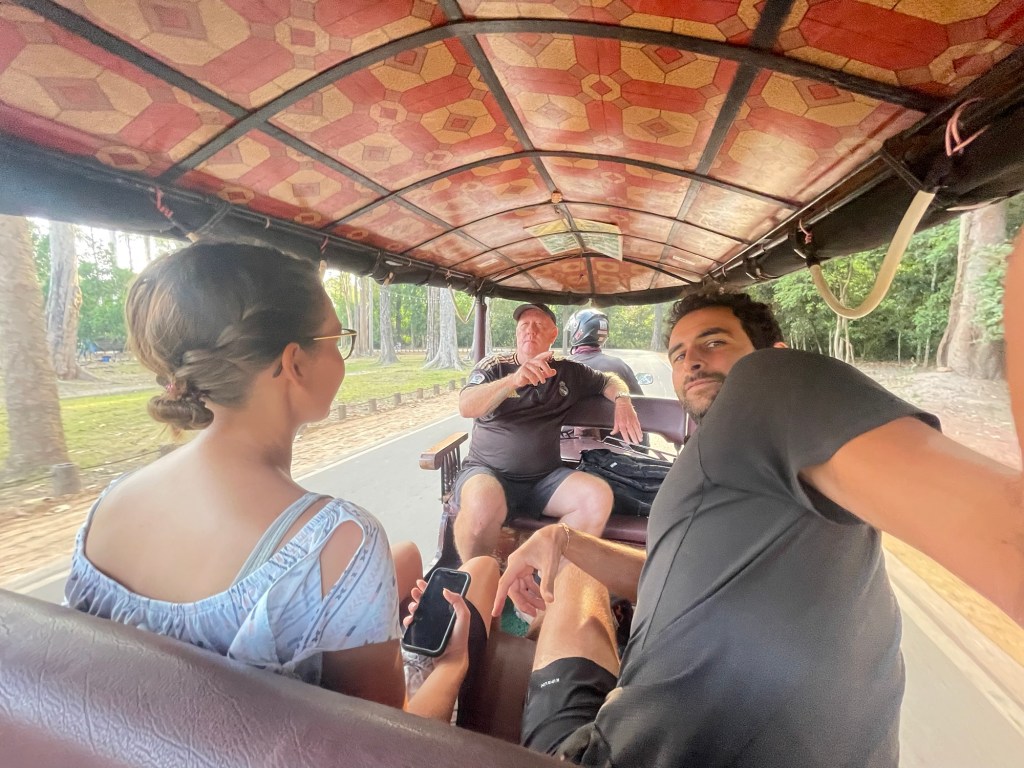
The premise of the tour company, that Scott was helping Pheak set up, was to visit temples off the beaten paths. Given the expansive nature of Angkor archeological park it wasn’t difficult to find temples that no one ever visited. Providing of course you had motorised transport. As we travelled towards, and through the main hub, we got more acquainted with our host for the day.
Scott had been living in Siem Reap for the last 10 years. He’d even been ‘trapped’ here for covid. He returned to America for half the year, fairly typical expat movements that we’d become familiar with. His adventures extending across South East Asia, as well as his current objective of visiting all 51 national parks in America. While he was in Siem Reap he had started exploring some of the little known temples that were littered all over the place. He’d also recovered from a stroke and that had kickstarted his desire to become more healthy again. For most of his life he’d worked as a respiratory therapist.
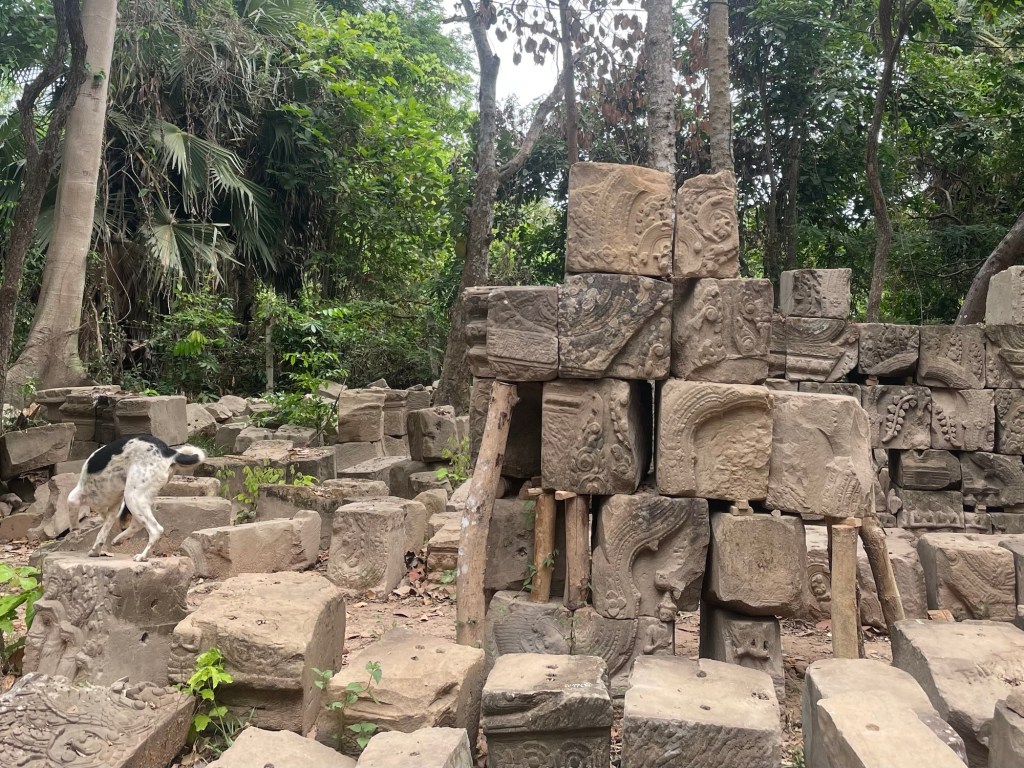
We arrived at a temple called Tro Moung. Pheak was being shown new things as much as we were. This temple had had some attempted restoration in the past. By restoration it meant trying to cobble the blocks together again. They were clearly not in the right position. It was now undergoing further ‘improvement’. Scott didn’t think much of their works either. There wasn’t any sign of archaeological input. It was underwhelming. There was a tiny cute puppy stumbling around through.
Next we headed north. It was hard to keep track of where we were going. Even Pheak was making wrong turns because we werr occupying Scott in conversation. Ta Oun was a single towered temple with a noticeably large ‘moat’. There were little bits of scaffolding holding up some of the different aspects. The doorways that don’t, and never have opened, symbolised gateways to heaven.

Pheak was redefining our understanding of where a motorbike and trailer could go. It was quite frankly ridiculous that he was able to drive down such bumpy sandy tracks with apparent ease. Banteay Thom was hard to find. Scott struggled to remember exactly which way to go. The sandy tracks crisscrossed each other through the semi open plains. The odd cluster of zebus grazing.
This was a larger temple. There were still tombstone like signifiers that showed the name and age. They weren’t unknown temples so much as they were only occasionally visited. The elevated entrance led to doorways half full of huge stone blocks. Lifting even one would be impossible for a single man. Around the perimeter, dark, well preserved cloisters had tiny accesses. Behind one of the towers stood the support of an over engineered scaffolding system.
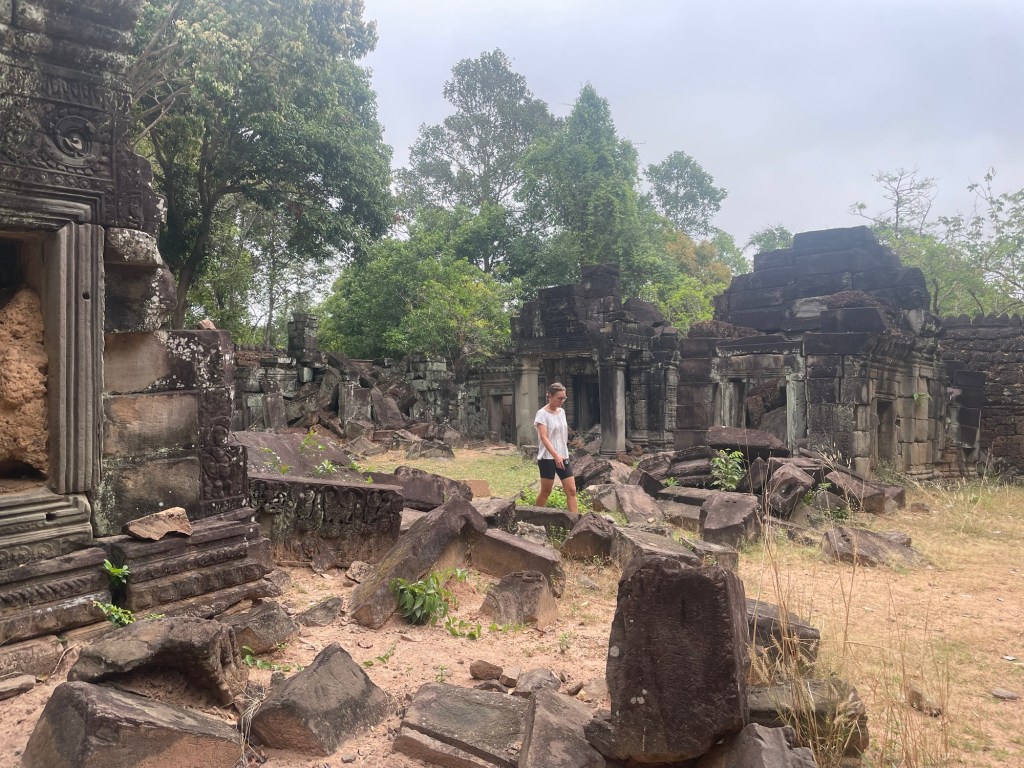
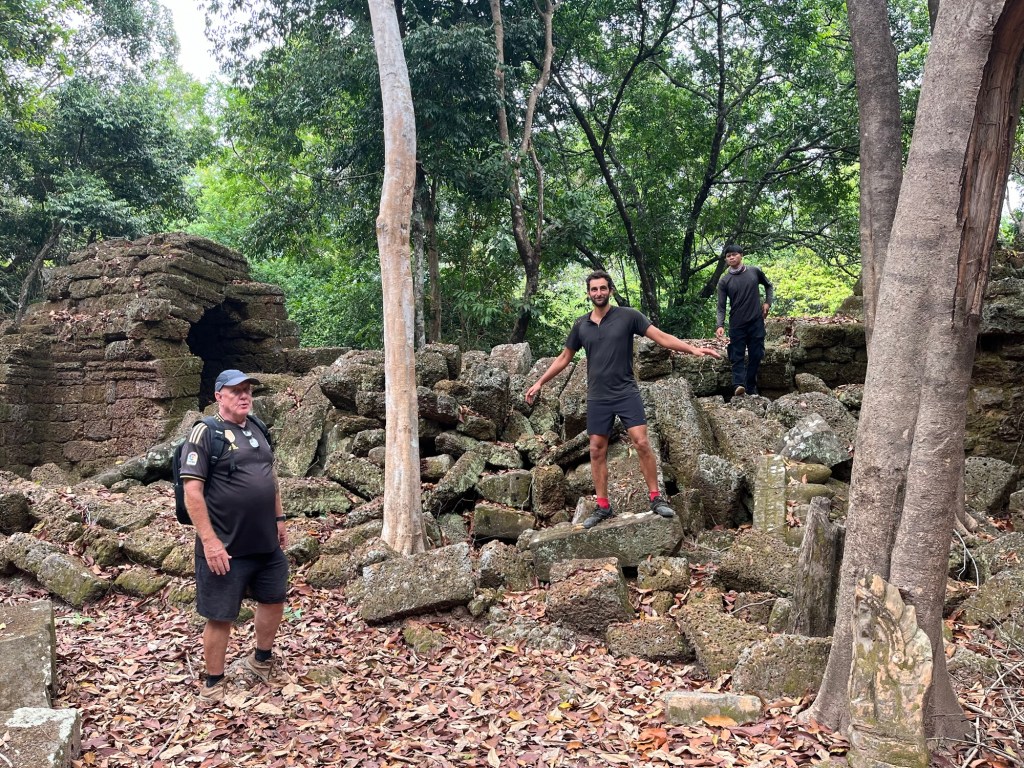
More dusty tracks, a quick stop to pump up the trailer tyres and we arrived at Phnom Dei. We had to walk through the jungle. We stopped at a shelter with a worn stone Buddha lying on its back. Pheak had apparently found the remains of its sister image, mostly buried, not far away. Deeper into the jungle, only half the doorways visible above the earth, were the remains of the temple. Interestingly to us, this older temple was constructed with small bricks. We had somewhat naturally assumed that the large stone blocks were the more primitive construction method.
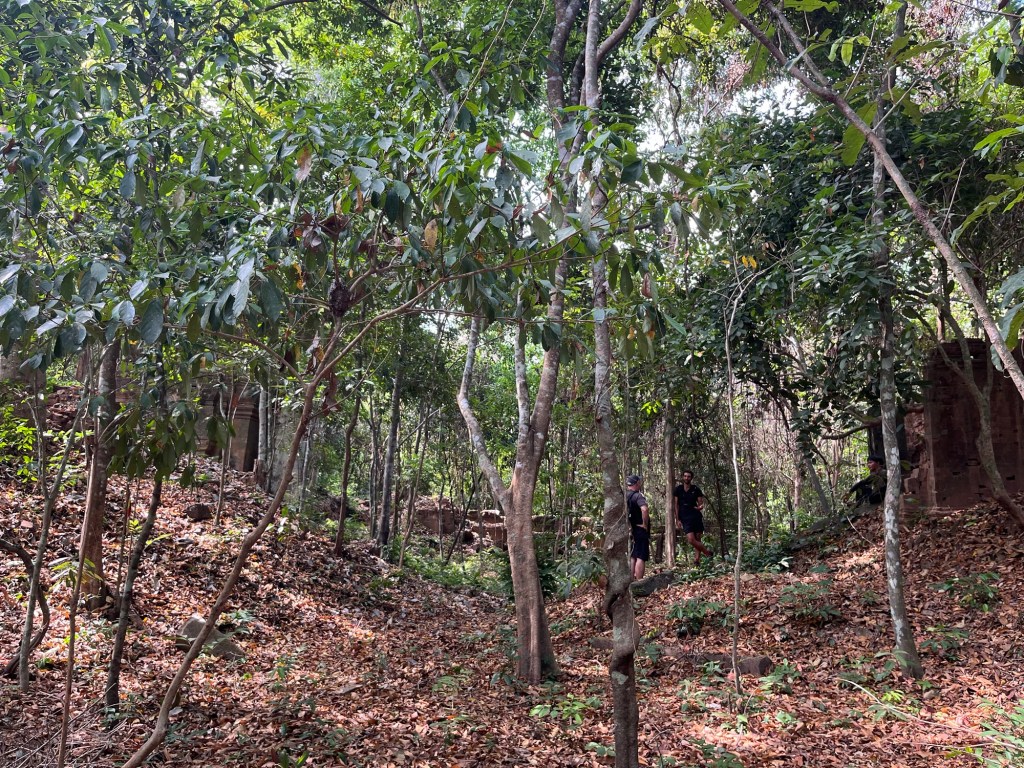
We ended up staying here for a while. Not only surveying the temple. Jonathan and Scott were getting into an in depth discussion about the benefits of technology and the importance of manufacturing rather than importing. Trump’s recent actions were responsible for the burst in interest.
Pheak continued to amaze us with his driving skills. The next road was under construction. It was in no way officially closed, but we wouldn’t have dreamt of driving over the piles of mud and through the deep sand. The bike and trailer would sink and slide but it wasn’t fazing our driver.
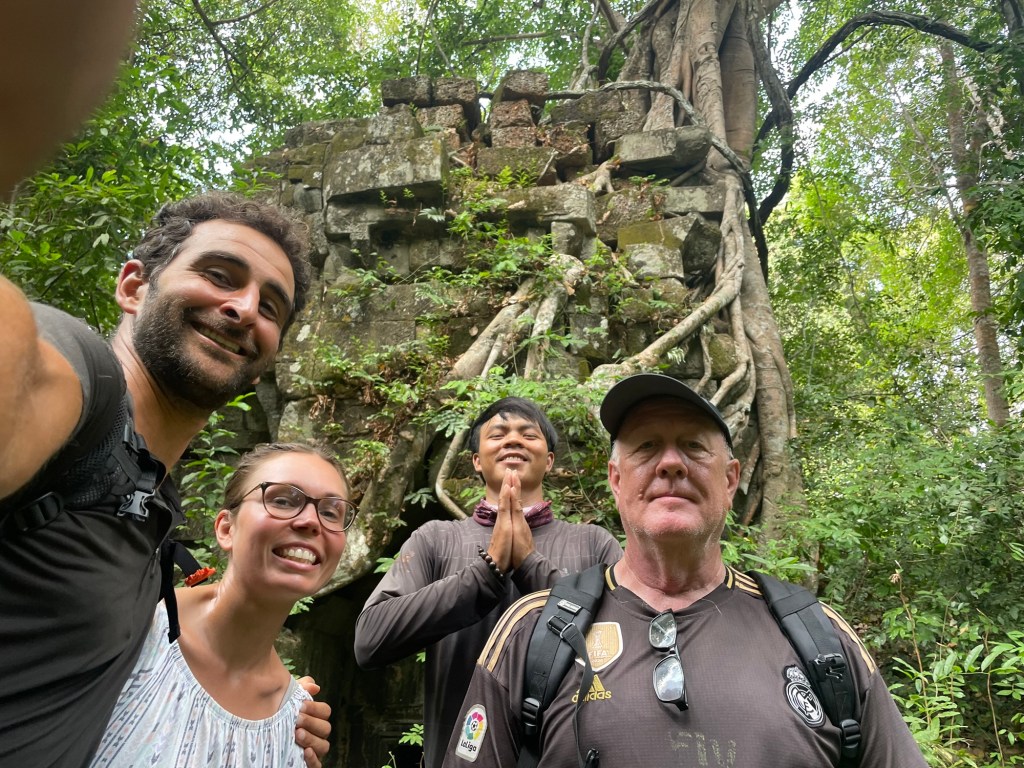
Khpob temple, Scott called it K-pop, was down an overgrown path just off the side of the dirt road. A single tower, it had a huge ficus tree growing on top. The roots had wrapped themselves around the blocks. It was a magical sight. This would surely be our favourite. It was hard to imagine somewhere being more like the site of a ‘lost’ temple. If it weren’t for the carved writing in the tree bark we’d be unsure anyone had ever been here before.

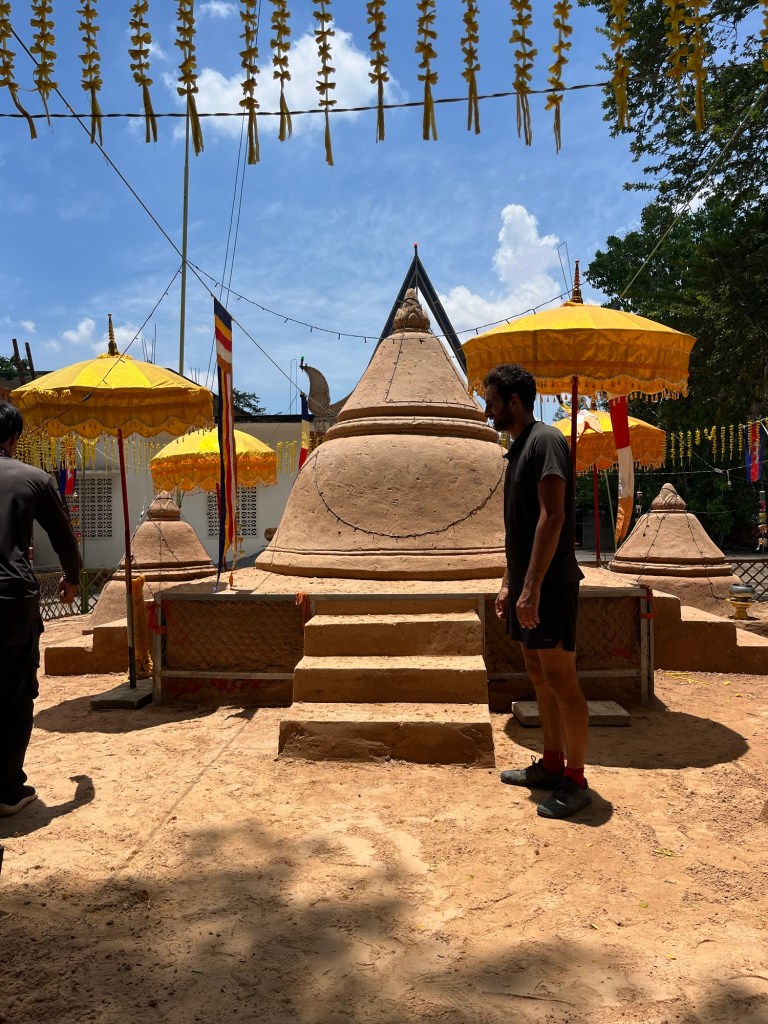
We stopped round the corner to have a coffee. Pheak ordered us an iced beverage made with coconut milk. Our next stop was Neam Rub. A modern pagoda had been built around a collapsed ancient temple. Nearby the traditional sandcastles had been built for New Year. Pheak explained that they symbolised the washing away of bad actions. Once the rain came of course. He didn’t believe it. Bad actions stay forever.
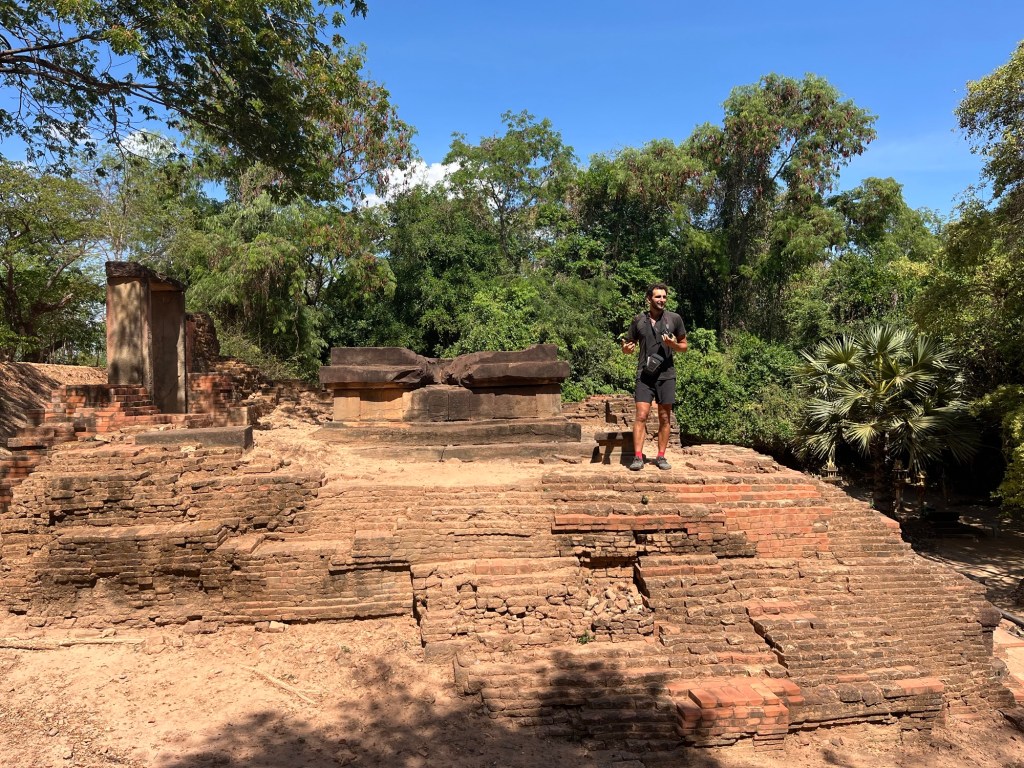
We’d originally thought that we’d be back at the hotel by noon. That would give us time to reset for the next day. But that wasn’t going to be happening. We were way too far away. Kok Por was a light coloured, small bricked, single towered temple, that had mostly collapsed. The name referred to a species of tree.

Spean is the word for bridge. Spean Memay was an ancient bridge that now crossed a now dry riverbed. The river wasn’t far away. The ground looked slightly cracked. It was quite a laterite structure. Huge blocks formed t-shaped supports. The road that joined either end was no longer visible. Despite being cloudy earlier on it was now intense sunshine. We felt bad for Pheak, exposed while we had the covering.

Now heading back south we were near the enormous, visible from the ISS, west Baray. Laying eyes on this huge body of water was like being near the sea again. Once again the idea of it being hand cut was mind blowing. The fact that it was probably mainly symbolic made it an even more incredible feat. On its south shore was Ak Yum. One of the oldest temples we’d seen. A giant male fertility statue sat in the centre. The walls were now entirely gone.
We were heading back into Siem Reap now. We passed many locals swimming, picnicking and eating by the waters edge. The lack of a proper road surface was a perplexing omission given the volume of traffic. As we got closer to the town, on a lovely tree covered road, it became louder and louder. Scott and Pheak delivered us back to the hotel. We said a fond farewell to our extremely generous hosts. We insisted Pheak take $20, which he very reluctantly accepted. He had told us earlier that he makes merely $2000 a year, and has no television or computer.

We collected our ‘breakfast’ boxes from reception and ate them by the pool. A vegan patty, two pieces of bread, some salad and two very small bananas. We wolfed it down having not eaten all day but it wasn’t very exciting. Afterwards we headed to the market, bought some tofu and salad, as well as some fruit. We ate it while watching Black Mirror, followed by The Shield. Of course we ate cake too. It was almost all gone. We crazily booked yet another night. We weren’t rested at all.
 Surly They Won't Make It